
O' How Our Children Sewed
I'm a National Trust member (of course!), and whenever I visit a Historic House... which is probably once a fortnight, there are always two things I try and look out for:
- Pet cemetaries
- Needlework samplers
This one, for example, is at Brockhampton in Herefordshire. It was made by Alice Cureton, daughter of one of the farmers on the site, aged 7 (!!) in 1865. It's framed in the room of the house her family dwelled in, and depicts not only the alphabet and number 1-12, but also, presumably, animals she would frequently see around the farm.

Alice's work really stuck out to me, because, even though I have been photographing samplers for a number of years now, I haven't totally stopped to admire their intricacy, or storytelling... there tends to be too much going on in any room to stop and look at one thing.
But, dear old Alice really caught my eye. Brockhampton itself is rather interesting because the noble family once resided in the house until around the 16th century, when they decided to build a grander, Georgian Manor, and leave the previous house to the new farm tenants. So, the home then 180'd and because a space for multiple families to live. The room itself where Alice and her family lived in was rather bare, so other than a rather lovely looking quilt, (which I don't think was 19th century), this was the prized possession in all the room.
It made me realise, of all the samplers I have seen, they're mostly made by children, the younger ladies, or daughters of the big houses, and they tend to be framed on the wall in a parlor, or bedroom, or morning room. A staple piece of needlework which you can find, possibly 90% of the time in some shape of form at a Historic House.
You can find a lot of information and archived samplers on the Victoria & Albert website which is where I have curated a lot of the following images from. The National Trust also have an extensive range of samplers in their archive.

The earliest dated sampler is from the 16th century. It is currently held in the V&A, and they is where our history begins. The concept of a sampler has not changed too much in it's 500 year story, but it is interesting, nonetheless.
16th Century

Like many handicraft professions in Tudor England, there was a guild of Embroiders. Male professional embroiders were members of the 'Worshipful Company of Broderers' which was chartered in 1561. Of course, membership to said guild was only available to men, but that does not mean women played no role.
Now, samplers specifically were utilised at this time as a type of portfolio, or pattern book. According to Palgrave's Anglo-French dictionary of 1530, samplers, or 'examplers' were known as for a woman to work by. They would hold a series of stitches that a woman could do, so that she could reference them in her sewing and mending.
Obviously, embroidery was around before these guilds. Just take the Bayaux Tapestry for example. Yes... it is an embroidery rather than a true tapestry. It was made in around the 1070s and depicts the events leading up to the Battle of Hastings and Norman Conquest of Britain in 1066. It's 70 metres long, and I'll probably do a separate blog post about it's history next year when it goes on display in England nearly 1,000 years after it was made.

The Bayeux Tapestry, Sourced from History Extra
So, people knew how to embroider for years before our earliest archival example of a sampler made in 1598. We can assume samplers, or examplers, pre-date the 16th century and were used for personal use to disclose the range of embroidery stitches one could complete.
Another thing to note, is that all these needlepoint pieces from this time and before are true embroidery. Whereas, the samplers we will recognise in Historic Houses are actually cross stitch. I'll get into that a little bit later.
17th Century

By the time we hit the 1800s, samplers aren't so much a personal reference piece for master embroiders, but instead a task young girls complete to showcase their needlework skills.
We see a change in samplers during this time from an assortment of random motifs, to an assortment of motifs that possibly tell a story, to orderly rows of depictions.
If you compare Jane Bostocke's 16th century sampler to the spot sampler from Montacute House, and Alice's sampler from earlier you can see this distinctive transformation of samplers into what we know of them now.
Some historians do class this period in the 17th century as the golden age of samplers because there is a unique growth in narrative, colour use, texture and format. It's almost developed from this cloth of 'reminder stitches', to something of a story, a piece of artwork that a child will be focused on perfecting for a series of time.
You'll find two distinctive types of sampler from this period. 'Spot Samplers' are the sort of 'messy' embroidery which include motifs almost randomly sewed onto the cloth with no rhyme or reason. Then you have the 'Band Samplers' which are the sort that make it out of the 17th century, and more frequently found frames on walls of historic houses. These ones were worked in orderly rows, and often reflected on each side of the cloth.
Sampler, unknown maker, 1625-50, England. Sourced from © Victoria and Albert Museum, London, Collections no. 1625-1650

18th Century

The 18th century introduced a squarer shape sampler, something that could be easily displayed compared to the longer rectangular samplers of past centuries. Embroidery from this era will be most prominent in historic homes, framed on the wall in the style of a painting, or print.
Many samplers from this time were still embroidered by young children. During this time they also began showcasing repeating patterns, alphabets and decorative boarders. Pictoral motifs, such as animals, flowers, trees, people and houses were personalised on samplers by the mid-18th century. Some even included moral or religious verses alongside the embroider's name, age and sometimes location.
As samplers progressed, they were more commonly embroidered on woollen rather than linen cloth, or grounds. This was because a woollen surface could easily be worked easily with the small range of stitches in a young girls skillset. It was also around this time that tent (diagonal) and cross stitch became popular.
19th Century

By the late 18th, early 19th century, samplers became more standardised. The sampler became a popular schoolroom activity for young girls in England, and it was worked almost exclusively in cross stitch.
Then, in the middle of the 19th century, something flipped and samplers tended to be used a models of professional work for amateurs to follow. Sarah Bland's work is stored in the V&A. She was a Victorian woman well known for designing and sharing her embroidery.

Sampler, Sarah Bland, mid-19th century, England. Sourced from © Victoria and Albert Museum, London, Collections no. T.240-1967
In the 1851 census, she was listed as a 'gentlewoman' i.e. a woman who belongs to a high social class. i.i.e she had no formal occupation and did not need to work for money. However, it is common knowledge that Sarah designed ample embroidery pieces, of a very high quality, and shared her work with other middle-class families.
These designs make a return back to Spot Samplers, where one would randomly place embroidered motifs on the cloth to showcase ability. Of all Sarah's samplers in the V&A collection, both the designs and embroidery seem to be cross stitch, and it does not appear she had a completed 'sampler', as in a framed version of a design like we would have seen a century before.
20th Century

According the the V&A, the First World War is reason for a decline in samplers come the 20th century. However, needlework guilds and art schools have since propped up to keep the skillset of embroidery alive. The museum commissioned the well-known embroider, Louisa Pesel in 1910 to complete a series of stitch samplers documenting historic English needlework stitches.
Multiple books were also written during this time, such as the 1920 book entitled 'Samplers and Stitches' written by Grace Christie (or Mrs Archibald Christie as is published). The embroidery in the book is less cross stitch, and more traditional embroidery like once would have been detailed on samplers from centuries ago.
We almost come full circle in terms of the heritage and history of samplers. From reference sheets to a schoolgirls task, to a middle-class lady's hobby, and so on. From embroidery to cross stitch and back.
Obviously, there are multiple books depicting the motifs of samplers available now. Many of these books detail the designs of samplers in museums, such as the V&A and Fitzwilliam Museum.
Samplers were not just an English contraption. Girls in America and Europe practiced needlework in schools, and would often create their own samplers like ones I have shown here. Quaker Samplers are another interesting version of sampler. To Quaker religion, needlework was viewed as disciplined, an again, part of the school curriculum. Young girls would embroider on plain linen, and, unlike the 'traditional' samplers I have showed you here, Quaker samplers were precise and focused on devotional words and religious texts. They omit the colourful, playful and childlike nature of previous samples, and tend to be embroidered in one colour thread without ornamental motifs.
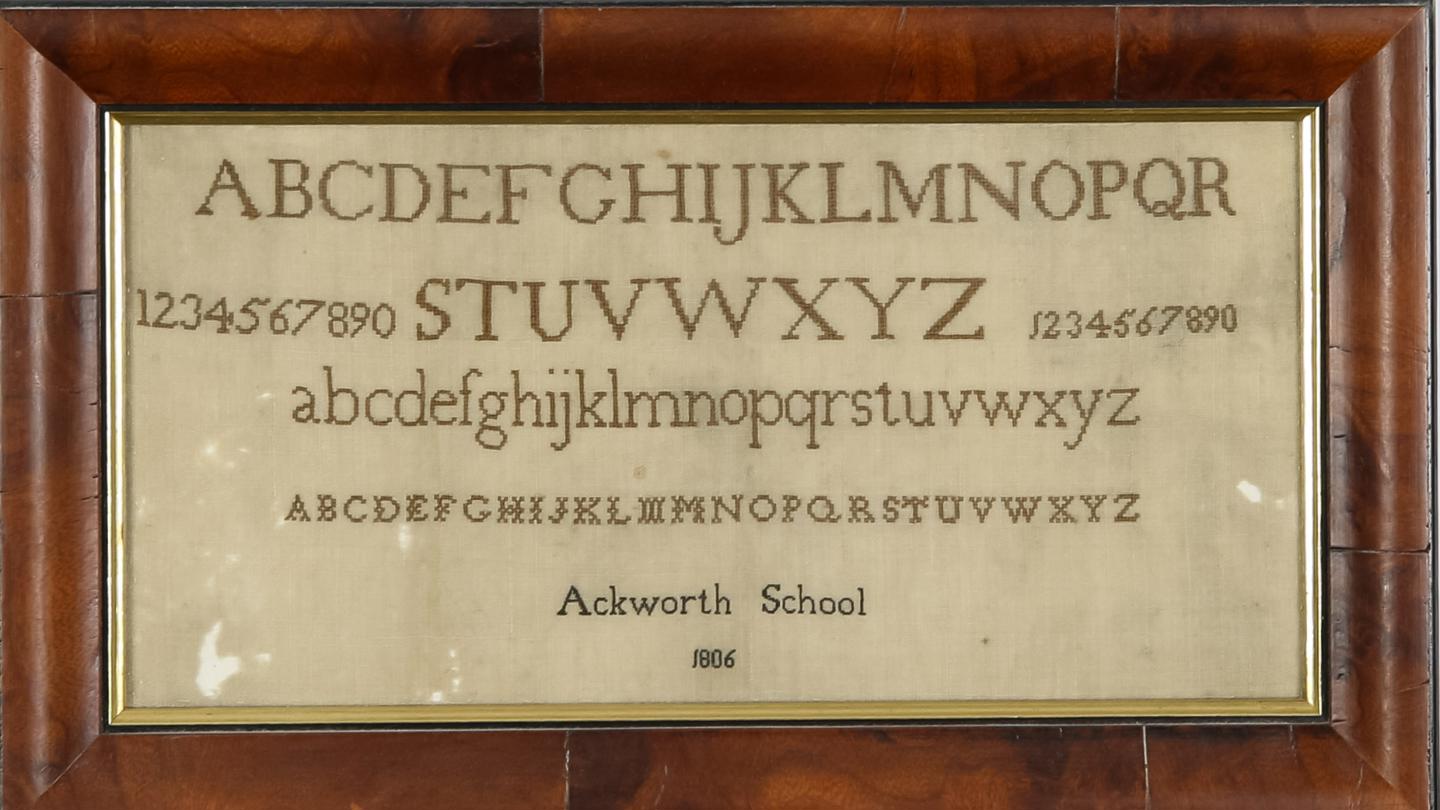
Sampler, Akworth School pupil, 1806, England. Sourced from © Catherine Southon
Now, did you catch that bit earlier on? No?
How about I give you access to a FREE kind-of sampler?

I designed this English Alphabet Stitch Grid early in 2026 following this baby blanket I knitted for some close friends. If you're interested, as a thank you for reading through this WHOLE blog, I'm offering you a free digital copy! Just add the Digital Download English Stitch Grid to you basket and use the code SAMPLERS at checkout!
Information Sourced from:
Embroidery - a history of needlework samplers, V&A, 2014
English Embroidery of the Late Tudor and Stuart Eras, Watt. M, 2010, The Met
gentlewoman, Cambridge Dictionary
Bland, Sarah (180-1905), Textile Research Centre, 2017
Delicate, Devotional and Distinctive: Why Are Quaker Needlework Samplers So Valuable? Catherine Southon, 2026