
The Traditional Knit Project [Part 3 - Guernsey's Construction]
Let's get into the knitty gritty, shall we!
In Part 3, I'm aiming to detail all the little construction techniques and delve into the DNA of a knitted guernsey jumper. 'What's a guernsey?' I hear you ask- let me tell you. But, before I confuse you any further, you might want to refresh on Part 1 and Part 2, and, also this blog on the difference between guernseys, jerseys and ganseys!
Right, let's get going:
Gladys Thompson's book Patterns for Guernseys, Jerseys & Arans has been such a huge reference whilst I've been researching my Traditional Knit Project. I recently found she'd written another one prior to this called Guernseys and Jersey Patterns, released in 1955. Apparently, it retails secondhand for nearly £70. Ouch! But, it's a book I will be extremely happy to come across! Another two books I've enjoyed using are The Complete Book of Traditional Knitting by Rae Compton, and A History of Hand Knitting by Richard Rutt, just in case anything here piques your interest. I'll link all my sources at the end of the blog, in any case. 
So, Thompson wrote in her book that at one time on Guernsey, there were possible multiple styles of jumper, based on the family, and/or the occupation, i.e fisherman or farmer. That's one thing I think really important to mention; even though I'm calling them 'Fishermen's Sweaters', they were also used by farmers, and then even sailors and lifeboaters... whatever they're called. But, nowadays, or at least since Thompson rewrote her book in the 70s, the design has been streamlined and most knitters make one standard style.
Overall, the guernsey is knitted bottom up in the round using 5ply yarn. The cast on is followed by a garter stitch welt that is knitted back and forth to create a slit in the side seams. This welt is finished with a 2x2 ribbed edge. Even though the jumper is knitted in the round, faux seams are worked up the body and also down the arms to create the illusion that is was knitted in panels. The shoulders are also reinforced, and follow a similar design style to the cast on edge, with garter and 2x2 rib stitch panels to mimic the waves in the sea and ropes of the fishing boats. Finally, the sleeves are knitted down towards the cuff from shoulder, to allow for ease if needed to undo and fix if it was to get caught, etc. The whole jumper is then finished with a diamond shape underarm gusset that allows better movement in the, already, quite tight knit, as well as it stops the whole body rising up if one was to lift their arms above their heads.
So, there's a super duper quick overview of the specific details located in a knitted guernsey, scroll on for a little bit of a deeper dive!
No.1 The Channel Island Cast On
A guernsey (and jersey!) starts with a Channel Island cast on. It's nothing like I've every cast on before, and even Thompson writes in her book that the guernsey should begin with a thumb cast in. I haven't tried it yet, but I think I'll get to grips with it when I get going. There's also a Channel Island Cast Off, for when you've finished knitting the sleeves- I'll get into that a little later.
To knit a Channel Island cast on, you'll need three strands of yarn. I've heard people recommend using three individual balls of yarn, so that you don't accidentally run out of wool half way through, but others have suggested anything between an 18-24" tail should be long enough. Two of these strands wrap around your thumb anticlockwise, whilst the third strand is used to create the stitch on the right hand needle.

The two- thick yarn creates a picot- style edging by making a knot every other stitch. It's supposedly very elastic, but also helps in keeping the garter stitch welt secure in place, giving it extra strength and durability.
No one really knows where the method came from, because it's nothing like a picot cast on at all. It sits especially well next to the garter stitch welt, and was possibly invented in order to ensure the cast on didn't fray, or come undone, because it would be far harder to fix than if it was a cast off edge, for example.
 Channel Island Cast on edge along the front of the welt, countrywool.com
Rae Compton has some really interesting instructions in her book, but equally there's a lot of really good tutorials online which you can follow, if and when.
No.2 Garter Stitch Welt
Moving up from the cast on: the welt.
This welt might look a little different from the welt you've knitted before, or it might not and I'm going to introduce you to something new, anyway! According to Collins Dictionary, a welt is 'a raised or strengthened seam or edge, sewn in or on a knitted garment'.
Guernseys and Ganseys and Jerseys tend to all use a knitted welt at the hem of the body. A guernsey's welt is typically of garter stitch make up (like above), followed by a few rows of 2x2 rib, whereas a gansey would often use a 1x1, or 2x2 rib, or even a cable, sometimes followed by a few rows of garter stitch.

Isn't a welt just a hem? Yes! It's used to prevent the curling up of the cast on edge and enable the jumper to sit flat against the body; it also creates a defined edge along the side splits which looks much better than if it was just plain stocking stitch.
But, why a 'welt'? I really wish I could answer this one. The term 'welt', according to Oxford English Dictionary, is a Middle English (1150 - 1500) word, primarily used when talking about shoes. The oldest evidence of the term is from 1425, describing a strip of material used to join, reinforce or finish an edge on a shoe. That's about as much as I can see without having to pay £100 to subscribe to a dictionary... what has the world come to.
I'll rage about the inaccessibility of heritage another time, but somewhere down the line between 1425 and 1850-ish, the welt became a word synonymous for the garter knitted edge of a guernsey. Apparently, according to the Online Etymology Dictionary, 'hem' is a 14th century word, so I'll have to go back and get a cleared understanding one day- or, if you know, please leave me a comment!

The pattern I will be using from Gladys Thompson's Patterns for Guernseys, Jerseys and Arans writes to work the garter stitch welt flat for around 20 rows on both the front and back of the body. These are then joined in the round ( a process I'm not looking forward to because I know there will be a huge twist somewhere, and I'll never be able to achieve it on the first attempt), and 6-8 rows of 2x2 rib are completed in the round. This leaves a little slit in the side of the welt, and will, hopefully, make the process enjoyable because I DETEST seaming- I always fail to make the seams line up, even when matress steaming.
Anyway, the body is pretty simple from there on out, it's knitted in the round in stocking stitch, or stockinette for my American friends, but with one little addition:
No.3 Side Seams
Yes, the humble faux side seam.

It probably sounds rather easy to just plop a purl stitch down the side of the body to make a faux seam, but from what I understand, it's a little more complicated than that. I say complicated, but all-in-all, the faux seam must line up with the purl stitches from the 2x2 rib after the welt, according to Rae Compton.
“At best, the seam stitches should flow upwards out of the welt, not simply being increased at the top of the welt as a last-minute addition.” Rae Compton, The Complete Book of Traditional Guernsey and Jersey Knitting, p.25
Why a faux seam? Well, it add structure to an already very heavy garment. When sweaters are knitted in the round without any texture, or side seams, they become tubes of endless knitting, blocks of stocking stitch with no real definition. False seams are super important when working with a drap-ier fibre, like linen or silk, and not always necessary when working with wool because it already has a lot of structure.
But, in the case of guernseys, ganseys and jerseys; fake seams really help in figuring out where the front ends and the back begins, and visa versa.
I've also heard that false side seams are purely for aesthetics, and whilst I agree, I think they probably do more than nothing; even if is just making a nice fold line for when I put them in the wardrobe. Like I've said: I HATE seaming... it took me 3 hours to mattress stitch my latest FO. I can never get them to line up even when I'm making identical stitches on either side, I don't know what happens, but, if I can knit something in the round and add a fake seam instead, you bet I will.
I did read a cool hack during my research, that might interest you if you're more into mindless knitting than adding in a few purl stitches every now and then. First off: place a stitch marker where the seam purls are so that you don't forget them. OR. If you really really don't want to purl: again, place the markers at the purl stitches, KNIT them as normal in the round, and then when you get to the armpit gusset: frog those stitches back to the 2x2 rib at the welt and, using a crochet hook or another needle, then purl them all the way up (or turn the jumper inside out and knit all the way up)!
No. 4 Underarm Diamond Gusset
When you think of a guernsey, or a gansey, what springs to mind? The navy blue yarn, the intricate cable patterns and designs on the chest, fisherman? Or, is it the genius underarm diamond gusset?

The tricky thing when knitting a fisherman's sweater of this construction, is to make sure the gusset starts in the correct position. Too early and the jumper will be too small, too late and you'll be knitting for longer. Essentially, the body-half of the gusset needs to be completed before the armhole shaping. Best practice is to give 3-4 inches prior to the armhole to add the gusset in.
There are patterns where the gusset is added in as working on the body, and also patterns where it's an afterthought. Specifically, Gladys Thompson's Patterns for Guernseys, Jerseys and Arans. Now, in her pattern, given to her by Messrs de Cartaret and le Patourel of Guernsey who were the proprietors of a popular men's outfitting firm on the Old High Street. They owned this store from around the 1860s- I can't find too much information on them, but, apparently they stocked classic menswear, and fisherman's clothing.
The way that the pattern in Thompson's book is written suggests it was translated from a machine knitted pattern. In modern times, Le Tricoteur use knitting machines to make the base of their guernseys, but require locals to hand finish the jumper, such as adding in the underarm and neck gussets, and finish the reversible neck.

Two residents of Guernsey knitting guernseys, n.d, Le Tricoteur
Thompson's pattern writes the body is completed all in one, and then steeked at the armholes for sleeves. Now, traditionally, a guernsey's sleeve is knitted top down, from shoulder to cuff- I'll go into it more later, so a gusset tends to be knitted in tangent with the sleeve. However, Thompson's pattern has the sleeve knitted up from the cuff, and what I understand, the gusset knitted in two halves (so body half, and sleeve half), cast off and then sewn together when the sleeve is set in.
Her book was released in the 1970s, and the first knitting machine was possible brought to the island in the 1960s, so it is probably that this pattern was adapted from a machine. Is it the right way to knit a guernsey gusset? I'm not sure. The pattern's I've read in relation to ganseys all speak of knitting the gusset as one whole piece of fabric. Maybe I attempt this version?
Anyway: benefits of underarm gussets?
- They widen the chest area by creating areas of extra stitches in each underarm. By stretching the body in the armpit to create a triangular (growing into a diamond shape) shape, the chest "grows" a small amount because it isn't pulled all the way around the the side seam any longer.
- By doing this, a greater range of movement is created in the upper part of the jumper. Remember, these are working jumpers used by fisherman who have to reach high on ladders and ropes and pull large nets on the daily. A guernsey is already quite a tight fitting jumper in order to keep the heat in, and water out. So, a little bit of freedom is required in the most used areas (the upper arms) to reduce the possible pulling and wear and tear.
The neckline also includes a triangular gusset for this exact reason.
No.5 Reversible Neckline
Ever picked up a knitted (or crocheted) jumper and suddenly though "which way is the front?". Weirdly, that's exactly the point of a guernsey.
The construction of this jumper is extremely boxy. It's just one huge rectangle with straight edges, straight sleeves, and a straight neckline. You'd call it a boat neck, a collar that just sits flat in a straight line from shoulder to shoulder.
The reasoning for this isn't because fishermen were getting dressed in the dark and couldn't work out which was the the back and the front. It's because it doesn't really matter which way is the back or the front.

A guernsey could be worn one day during the working day and then flipped around in the evening when out at the pub, or having dinner. It also meant that a jumper wouldn't wear down as quickly because it was getting flipped around frequently before the wool would wear down from continuous use.
Similarly to the armpit, gussets are incorporated into the neckline. These are triangular shaped and finished one after the other. The shoulders are seamed together using a kind of three-needle bind off to create this thick band of stitches along the top. One shoulder is worked, then knitted across to work the other, then that neck gusset is worked, back over to the other side, and then the 2x2 rib of the neck is completed in the round and cast off.
Gussets are different in guernseys and ganseys, specifically the Scottish ganseys which have buttons sewn into their neckline.
No.6 Sleeves

Like I mentioned, sleeves tend to be knitted from the top down, in most gansey patterns, and from my research, guernseys are the same. However, Thompson writes that the sleeves begin at the cuff and are worked upwards, and then sewn onto the hem created by steeking the body into armholes.
The reasoning for creating sleeves downwards towards the cuff is another nod to the practicality of the garment. It's far easier to undo a cast off edge and rip back to a mistake, or a huge hole, than to undo a cast on. So, when the jumpers are worn out, you know; holes in the elbows, loose bits of yarn where they've been caught and tugged- it's easier to unravel to a certain spot, finish at the cuff and away you go.
Sleeves on guernseys, ganseys and jerseys are also notoriously shorter than you would find on conventional traditional sweaters. Again, a nod to their huge practical nature. Image you're pulling sopping fishing nets over the edge of the boat day in and day out. Imagine how wet your sleeves are going to get, imagine how much they'd tangle if it was a looser fitting construction. By creating tighter and shorter sleeves, fishermen didn't necessarily have to worry about rolling up their sleeves and keeping them neat and tidy.
The sleeves have 2x2 rib stitches at the top where they join the body, similar to the rib found above the garter stitch welt. This motif is worked in conjunction with the underarm diamond gusset. Once that has been completed, the sleeve is the decreased at the underarm alongside the seam. Remember; the purl seam runs the whole way down the sleeve and into the 2x2 rib of the cuff, same as the welt.
A sleeve needs to be around 6 inches at its narrowest point. I've not found any mention of how short lengthwise the sleeve needs to be, but looking at archival photos, a lot of the time the cuff ends about 2 inches from the wrist. Personally, I prefer my sleeves to be a little bit longer because I get cold hands and I like the option to as much of me warm as possible. Maybe I try knitting the sleeves shorter and see how weird it feels.
No.7 Stitch Representations

I also mentioned earlier, I think (it's been a looong blog, so thanks and well done for getting this far), that guernseys are a little simpler in design compared to a gansey or jersey.
That doesn't mean that the motifs they do have aren't there for a reason. Each design element in this jumper has a meaning, whether that a specific construction technique, or a simple stitch pattern.
My latest illustration The Secret Language of Knitted Guernsey Jumpers details all the construction details you'll find in this rather straightforward- looking sweater. And, like we've gone through: there's a lot. But, I haven't designed anything to mention what the stitches represent. If it's something you're interested in, please pop a comment down below and I'll see what I can do!
When you look at a guernsey, it's a lot of knit and purl stitches. It's very similar with a gansey and jersey too; cables are typically reserved for aran sweaters, not to say you won't find then in a gansey pattern.
The knits and purls on a guernsey, however, mean different things in different places, as you can see from my illustration above! They may be the same stitches, but each element has its own story, and each element means something special to a fisherman.
You can also get initials purled into the body if a guernsey, above the welt on the front:
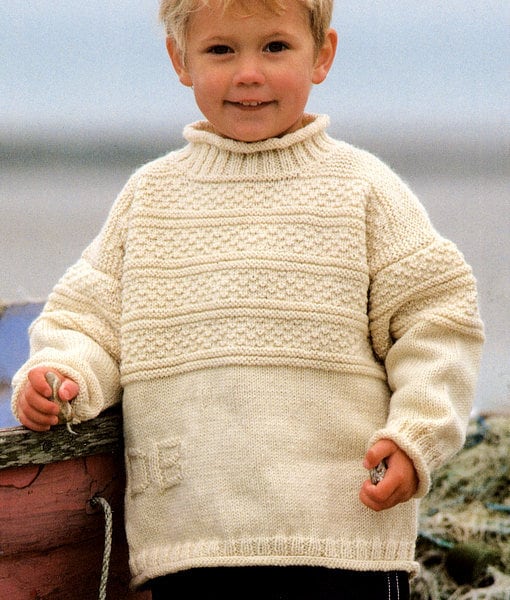
Purled initials on the bottom left of the child's gansey, Etsy
I was trying to locate a photo of initials, and this is genuinely the best photo I could find in which you could actually make out the letters. The knitter tended to add the initials of the wearer, rather than a mark of who made the jumper. It wasn't common practice, because it's quite a special occurrence to come across an archived jumper, or a photograph with someone wearing their initials. I do think it's a nice touch, especially if the jumper is well kept enough to hand down through generations.
No.8 Yarn
Guernsey jumpers use a 5-ply worsted yarn. It's a whole thing that I've gone into on this blog if you're interested in a deeper dive into that side! Initially, worsted wool is combed rather than carded so that it doesn't have as many fibres splitting off from the ply.
I'm looking into getting wool from Frangipani 5-ply Guernsey Wool to knit my guernsey in, and I'm definitely leaning towards a Navy Blue colour. You can order a colour card of sample yarns if you pop them an email- all the info is on their website.
Worsted wool is less likely to pill, and is also a lightweight wool that both keeps you warm and cool. Wool is also naturally water repellent. Now, does this mean you'll be kept warm and dry in a huge downpour? No. But, if there's a spray from the sea or a slight drizzle or rain, you're less likely to feel like you're getting damp.
Onto colour. Navy is the colour of fishermen's guernseys. If we travelled to England, or Scotland you may find different colours were preferred, but in this instance Navy is the go- to.
Sailors, on the other hand preferred stripes as Richard Rutt writes in A History of Hand Knitting. From Dickens in 1835 writing about sailors wearing blue striped guernsey shirts at a picnic (I'm sure that's what he said), to Estonian teams wearing white guernseys with pale blue facings in 1839 (football??). Or an amateur boatman wearing a striped guernsey in 1845, to sailors in guernseys in 1861.
I believe, in these instance, they are taking about jersey fabric, a stretchier, smaller ply knitted wool shirt. Because, I couldn't imagine a sportsman and a fisherman wearing the same thickness of sweater, but if definietly requires more research!

Whilst I think a striped guernsey would be great fun, and I always love a stripe, I think I'll stick with the traditional for now. Who knows, I might want to make another in a fun colour... there are so many pretty ones to choose!
So, there you have it! That's the blueprint for the guernsey jumper I am attempting to knit. I run this studio interdependently, and I rely entirely on shop sales to fund my research and the raw materials required for these historical replications. The traditional 100% Pure British wool costs £50.00 to source for a full garment. Every order placed from this blog gets me one step closer to completing my Traditional Knits Project.
If you want to help me knit this jumper, please grab a The Secret Language of Knitted Guernsey Jumpers or something else entirely, from my website. It is truly the absolute best way to help me buy the yarn and cast on.
Sources:
Gansey Glossary, Sheringham Museum, 2020
Ganseys for Dummies, British Textile History, penelopehemmingway.com, 2012
A History of Hand Knitting, Richard Rutt, 1987
Patterns for Guernseys, Jerseys & Arans, Gladys Thompson, 1971
The Complete Book of Traditional Knitting, Rae Compton, 1983
Gansey Nation, Gordon Reid
1 comment
If you want help with your guernsey/gansey e mail me. I’ve written about them, designed them, knitted them, handled historical ones and catalogued them. Happy to pass on any info I have.